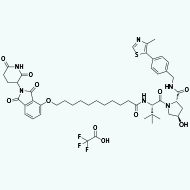
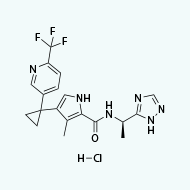
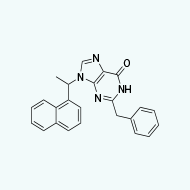
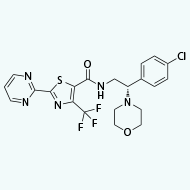
[MedChemExpress ; MCE] New Bioactive Molecules for April 2022
작성자
abbabio
작성일자
2022-04-06
조회수
538
MCE (MedChemExpress) provides a wide range of lifescience biochemicals, including more than 30,000 bioactive compounds, dye reagents, peptides and natural compounds for laboratory and scientific use. If you need these products, please do not hesitate to contact us via sales@MedChemExpress.com.
Potent antimalarial and orally active, selective Plasmodium DHODHs inhibitor.
•
Shows inhibitory activity against P. falciparum DHODH (PfDHODH, IC50=95 nM), P. vivax DHODH (PvDHODH, IC50=52 nM) and Pf3D7 cells (EC50=12 nM), with no inhibition of the human enzyme.
Solubility: DMSO : 100 mg/mL (226.83 mM; Need ultrasonic)
Research Area: P2X7 Receptor Antagonist/Neuroinflammation and CNS Diseases
•
Orally active, rodent-active, and CNS-penetrant P2X7 receptor antagonist (IC50s=12 and 2.4 nM for human and rat P2X7 receptor, respectively; Kis=22, 54, and 13 nM for mouse, human and rat P2X7 receptor, respectively).
•
Has the potential for the research of CNS disease.
Solubility: DMSO : 125 mg/mL (251.04 mM; Need ultrasonic)
MCE Annexin V-FITC/PI Apoptosis Detection Kit provides a rapid and convenient method to detect cell apoptosis and necrosis. After staining, live cells show little or no fluorescence (Annexin V-/PI-), early apoptosis cells show green fluorescence (Annexin V+/PI-), late apoptosis cells and necrosis cells show red and green fluorescence (Annexin V+/PI+).
MCE Cell Cycle and Apoptosis Analysis Kit (PI staining) provides a convenient method to detect cell cycle and cell apoptosis. The content of DNA is changed with the process of cell cycle. DNA can be stained by fluorescent dye, such as Propidium Iodide (PI), to measure its intensity by flow cytometry to monitor the cell cycle distribution in G1/S/G2/M phase as well as apoptosis cells with signals at sub-G1 region.
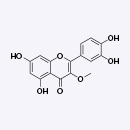
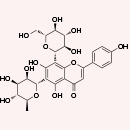
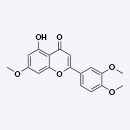
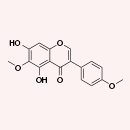
Flavonoids
Flavonoids refer to a series of compounds synthesized by connecting two benzene rings (often referred to as A ring and B ring) with three central carbons. They are called flavonoids because their structure contains ketone groups, and their color is often yellow. Flavonoids widely exists in nature. Most of them combine with saccharides to form flavonoid glycosides in plants, and few of these exist as aglycones. Generally, flavonoids can be divided into several subgroups such as flavones, dihydroflavones, chalcone and isoflavones. Flavonoids have a wide range of activities. For example, Rutin, a common flavonoid in nature, has antioxidant, anti-inflammatory, and antiviral activities, and Silymarin derived from Silybum marianum has antiviral and anti-tumor effects.
Markedly inhibits TGF-β1-mediated migration and invasion by deactivating epithelial-mesenchymal transition (EMT) via the TGF-β/Smad and PI3K/Akt/mTOR pathways in HCC cells. Exhibits no cytotoxic effects on normal liver LO2 cells.
Possesses potent anti-inflammatory effects in LPS-induced macrophage cell line mediated by inhibition of release of inflammatory mediators, NO, PGE2, and pro-inflammatory cytokines. Significantly induces reduction in the mRNA __expression__s of inducible nitric oxide synthase and cyclooxygenase-2.
Address: Bergkällavägen 37C, 192 79 Sollentuna, SWEDEN
Social media
Products are for research use only and are not intended for human use. We do not sell to patients. We respect your privacy and do not share or sell your information to third parties. If you no longer wish to receive these emails you may unsubscribe at any time.